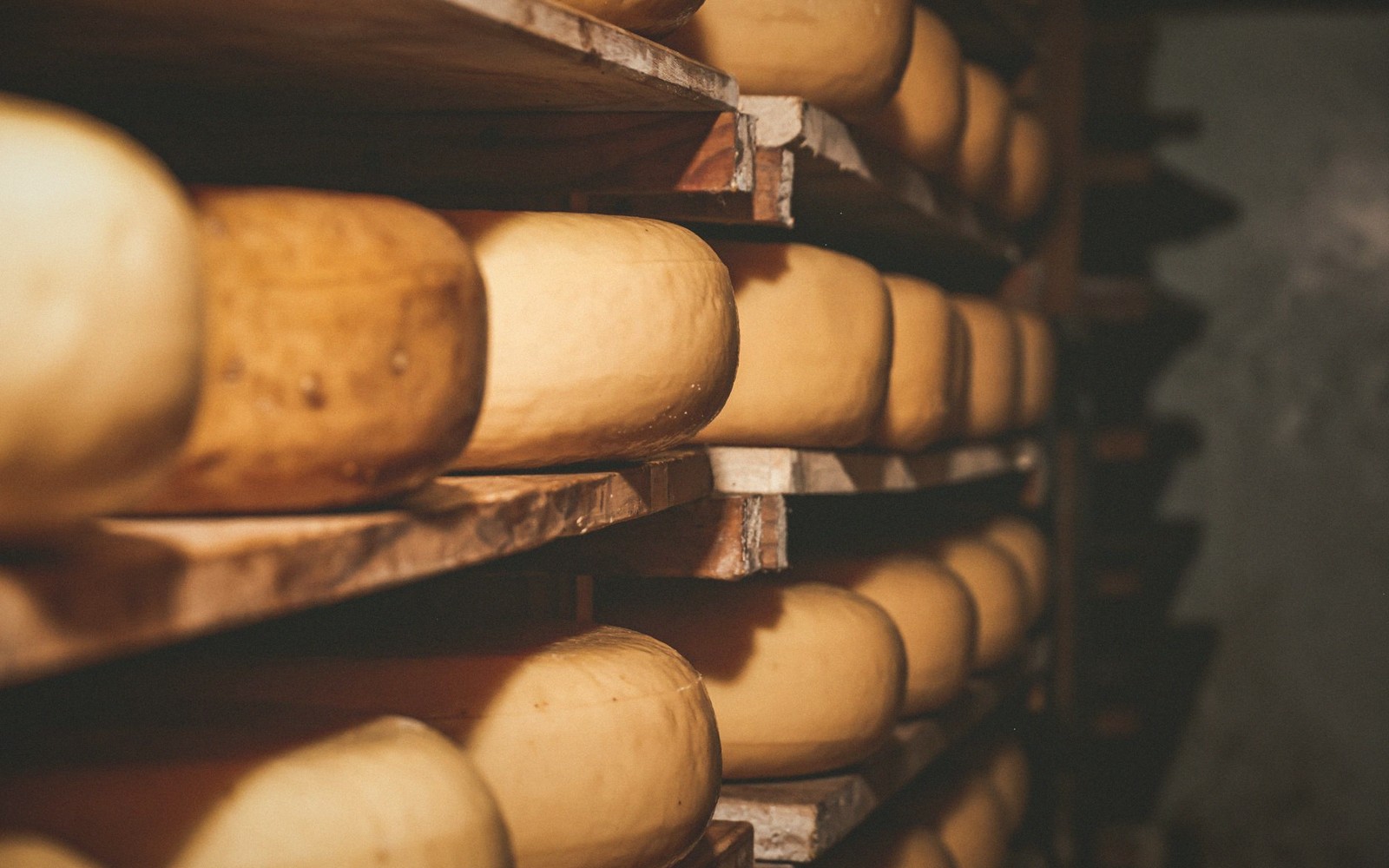
The great mountain cheese of Savoie — where it comes from, why it matters, and how to eat it properly.
1A cheese with a postcode
Beaufort is not a generic alpine cheese. It is a controlled AOC product, meaning only milk from specific valleys in Savoie — Beaufortain, Tarentaise, Maurienne and Val d'Arly — can legally go into it. The cows must be Tarine or Abondance breeds. The milk must be raw and whole, pressed the same day it is collected. This is a cheese that insists on its geography with unusual force, and the Maurienne valley below Saint-François-Longchamp sits squarely within that territory.
The wheel itself is unmistakable: a great concave disc, its sunken edges the result of a beechwood hoop drawn tight during pressing. Wheels weigh between 20 and 70 kilograms. The rind is smooth, grey-gold, almost architectural. Inside, the paste is ivory-yellow, supple, with almost no holes — unlike true Gruyère, Beaufort contains very little gas during maturation, which is why the French call it le Prince des Gruyères: all the richness, none of the eyes.
2What altitude does to the flavour
Affinage — maturation — runs for at least five months, and for the summer-milk variety, considerably longer. Beaufort d'Alpage, made from the milk of herds that have spent the summer on high pastures above 1 500 metres, is the rarest and most prized. The meadows above the resort, full of gentians, thyme and the aromatic grasses of the Lauzière massif, translate directly into the cheese: the fat carries flavours you simply cannot replicate at lower altitude, giving alpage wheels a depth and faint floral note that aged supermarket Beaufort never approaches.
Beaufort d'Été — summer Beaufort — is a step down from alpage but still a world away from the winter product, when cows are on hay. All three grades are worth trying if you encounter them side by side: the difference is a quiet education in what a mountain does to food.
3How to eat it
Resist the instinct to melt it. Beaufort in a fondue is good; Beaufort sliced and eaten slowly at room temperature, with a glass of Chignin-Bergeron or a light Mondeuse from Savoie, is better. In a resort chalet, a chunk on a wooden board with cornichons, a little air-dried bresaola and good bread is as honest a lunch as the mountains offer. Look for wheels sold in local fromageries rather than vacuum-packed slices: the cut surface should smell of warm milk and hay, not plastic.
Buy it. Take some home. The altitude came with it.