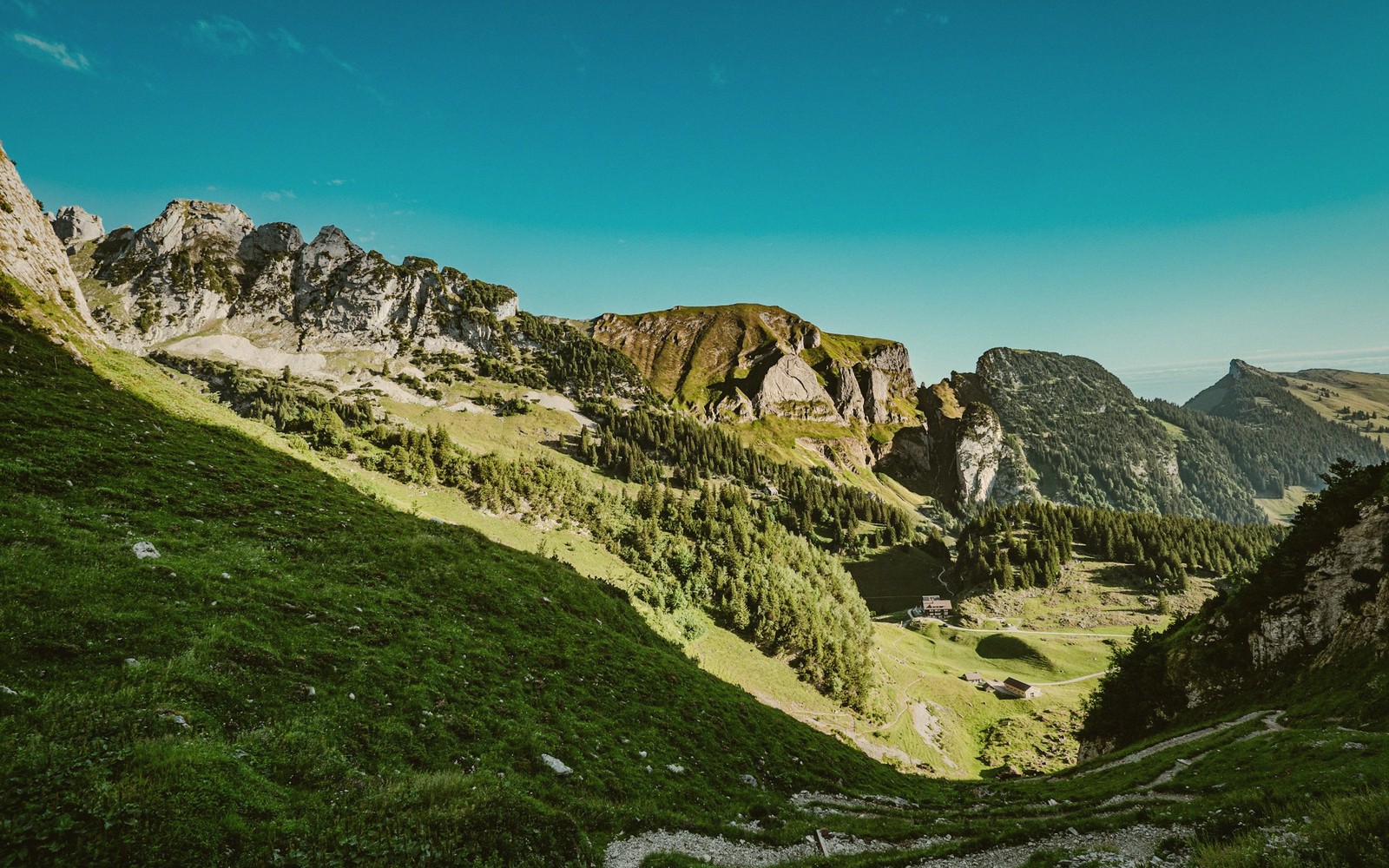
From gentle meadow loops to high balcony paths, the walking above Saint-François-Longchamp earns its altitude.
1The Lift Goes Up, the Crowds Stay Down
One of the quieter truths about Saint-François-Longchamp is that summer doesn't strip the resort of its main asset — the lifts keep running through the season, giving walkers access to terrain that would otherwise take two hours of lung-burning ascent to reach. Step off a gondola at around 2,000 metres and the Lauzière massif opens out to the west, the Maurienne valley drops away below, and the Col de la Madeleine sits on the skyline like a stone threshold. The views that skiers flash past in winter become, in July and August, something to stop and read properly.
The network of marked trails fanning out from the resort covers a broad range of ambitions. There are easy loops suited to families with young children, longer balcony traverses for anyone who wants a genuine half-day in the mountains, and wilder approaches toward the ridge that separates the resort from the Valmorel side. The trails are clearly waymarked using the French system — coloured blazes on rocks and posts — and most of the obvious routes are maintained and signposted at key junctions. A trail map is available at the tourist office in the village; pick one up before you head out, since phone signal on the higher paths is unreliable.
2Gentle Ground: The Meadow Loops
For a first morning, or for families with small children, the best strategy is to take the lift to mid-mountain and walk the broad paths that contour through the summer pastures below the upper lifts. These open meadow trails are largely flat or gently rolling, surfaced by generations of cattle as much as by any trail crew, and they reward a slow pace. Between June and August, the slopes that were pisted in January fill with wildflowers: gentians, alpenrose, mountain clover, and the yellow flare of arnica in the longer grass. The alpine meadows in flower are one of the resort's genuinely underappreciated summer pleasures.
The hamlet trail down toward Montgellafrey makes an excellent variation — a route that follows old mule paths through larch forest, past stone barns and the remnants of a pastoral economy that shaped these slopes long before anyone thought of pointing skis down them. The descent to Montgellafrey is steep in places but well-graded; the return by lift takes fifteen minutes.
3Higher Ground: The Balcony Paths
For walkers who want more, the real reward lies higher. The balcony paths above 2,000 metres — particularly those that traverse toward the Col de la Madeleine — offer the kind of walking where you feel the scale of the landscape properly. The Maurienne valley, hundreds of metres below, resolves into a thin grey line of road and river threading between dark forested flanks, with the peaks of the Vanoise visible on clear days to the east.
The trail toward the col itself is achievable for any fit walker in good conditions; the route is used regularly in summer and the upper sections, though exposed, are well-signed. Carry wind layers regardless of the morning temperature — the col sits at just under 2,000 metres and afternoon cloud builds quickly in summer. Those who make the climb find a saddle with an extraordinary panorama: the Lauzière massif behind, the Beaufortain ahead, and the long view north toward Albertville. Cyclists will be sharing the road on the far side; the col is one of the Savoie's great cycling climbs, tackled from both directions by enthusiasts throughout the summer season.
The area around Les Envers and Le Grand Bois offers shadier alternatives on hot days — trails that cut through mixed forest on the lower flanks, cooler and quieter than the open ridge. Le Grand Bois in particular has a reputation among locals for being at its best in early morning light, when the larch needles hold the dew and the birds are still working the undergrowth.
4Practical Notes
Start early. The mountains around Saint-François-Longchamp follow an Alpine summer rhythm: mornings are typically clear, afternoons bring cloud and, frequently, short sharp thunderstorms. Most walking trips are best planned to be at their highest point before noon and heading back to lower ground by early afternoon.
Footwear matters more than beginners usually expect. Even on marked paths, the terrain is uneven, and the high trails cross rocky ground where a boot with ankle support makes a real difference. Light trail runners are fine for the meadow loops; anything above 2,000 metres deserves a proper walking boot.
The lifts that serve summer walkers do not run continuously — check the posted schedule at the lift station before planning your ascent, as operating hours are shorter than in winter and vary through the season. The tourist office maintains an up-to-date timetable.
What the resort offers in summer, at its best, is unhurried access to genuine high mountain terrain. The trails are there; the altitude is real; and in the middle of July, with the meadows in full colour and the col clear on the horizon, it is hard to argue that Saint-François-Longchamp is purely a winter destination.