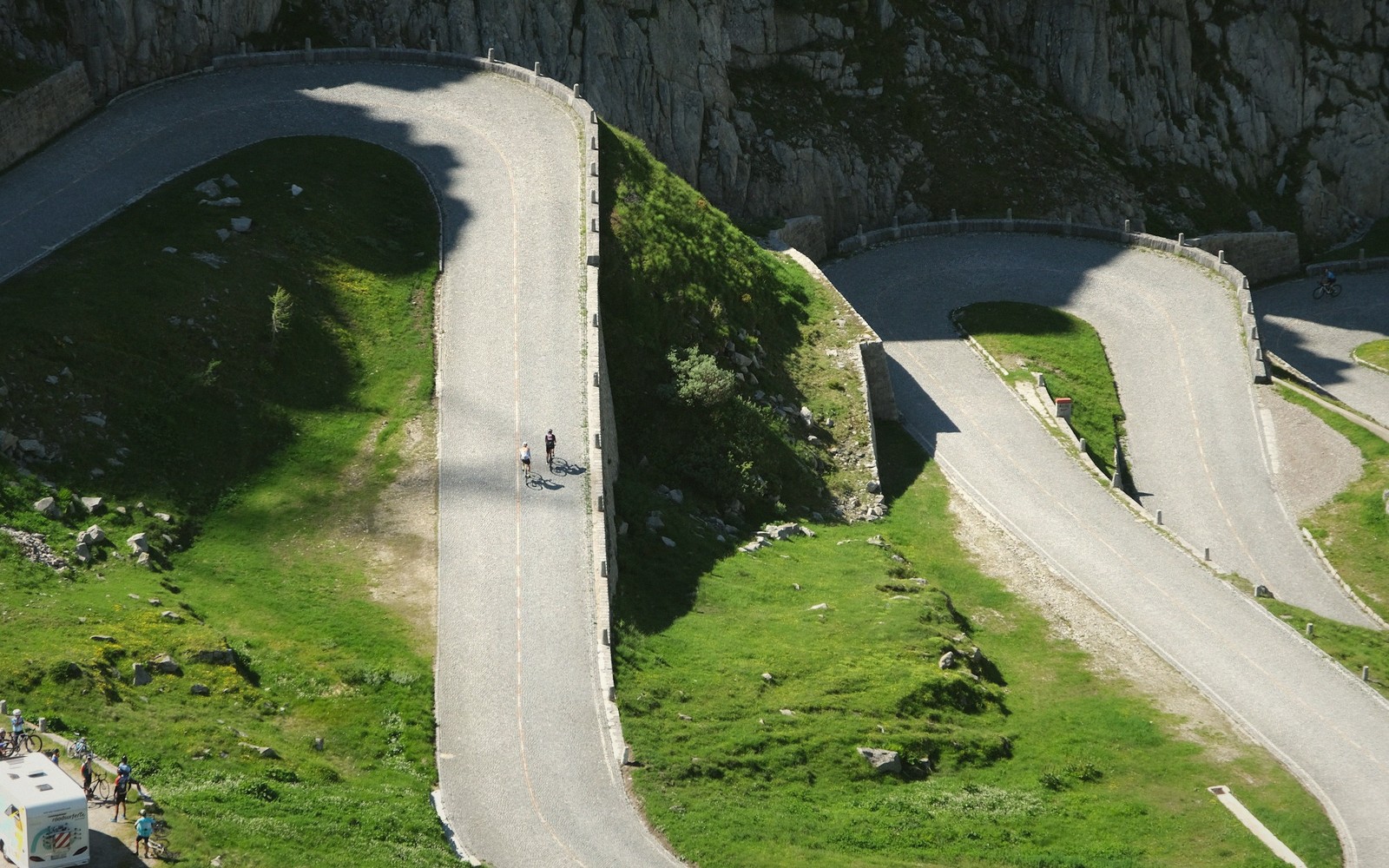
Climb the Col de la Madeleine, a Tour de France legend, from Saint-François-Longchamp: about 550 vertical metres to the 2,000 m summit.
Few mountain passes earn the word legendary honestly. The Col de la Madeleine does. Rising to 2,000 metres above the Maurienne valley, it has featured repeatedly in the Tour de France, breaking time gaps and breaking riders in the same afternoon. From Saint-François-Longchamp, you are positioned at altitude on its southern flank — which means you can climb to the summit with far less vertical gain than the riders grinding up from the valley floor, or descend the whole face toward the Maurienne and turn around whenever your legs say so. Either way, the road is yours.
1The geography: why this climb matters
The Col de la Madeleine connects two worlds. To the south, the Maurienne — that long, sun-baked valley carrying the Arc river and the motorway toward Italy — lies several hundred metres below. To the north, the Tarentaise and the approach to the Beaufortain. The pass sits on the boundary between the Lauzière massif and the higher ridges above Saint-François-Longchamp, a piece of rock that has divided and connected Savoie's valleys for centuries. The Lauzière massif across the valley is the view you carry for most of the ascent from the south — a broad, boulder-strewn wilderness that makes the road feel small and the effort feel worthwhile.
For a cyclist, the appeal is specific: the road is consistently challenging without being brutal, the tarmac is well-maintained for an Alpine pass, and there is genuine variety in gradient and character as you climb. The Madeleine is not a monotonous wall. It breathes, flattens briefly, then rears again. On a clear day, the views south across the Maurienne open into something vast — a panorama stretching toward the Écrins, the Belledonne, and on the clearest mornings, the Vercors plateau fading to the horizon.
2From the resort to the summit
Starting from Saint-François-Longchamp at around 1,450 metres, you are already well up the southern face. The summit sits at 2,000 metres, which means a climb of roughly 550 vertical metres from the upper village — a serious workout, but achievable in under an hour for a strong rider, and a satisfying two-hour round trip for anyone pacing themselves sensibly. The road winds through open pasture and patches of larch before the treeline dissolves entirely and the hairpins tighten against bare, rocky ground.
The final kilometres are exposed. Wind is a genuine factor up here — a tailwind on the way up becomes a headwind on the way back, so check the forecast and plan accordingly. There is a summit car park and a small col building that tends to be open in summer, though services at the top are basic and should not be relied upon. Bring water, a gilet for the descent, and more food than you think you need. The summit is not a place to linger cold and hungry.
If you are arriving by car or bike from the valley below, the climb from the Maurienne floor adds substantial distance and altitude. The route from La Léchère on the northern side, via the Tarentaise, is a different proposition again — longer and more gradual. For most visitors based at Saint-François-Longchamp, the southern face from the village is the obvious line, and it is enough.
3The Tour de France connection
The col entered Tour folklore early and has never really left. It has been used as a summit finish and as a mid-stage summit, and the behaviour of the road — its ability to split a peloton, to reward a climber who attacks on the upper hairpins — has made it a favourite among race directors when the Tour swings through Savoie. To ride it is to feel, in some faint physical echo, what the professionals experience when they come through here at race pace, twenty stages into a grand tour, crowds pressed against the barriers on the hairpin bends.
Out of season, the road is quiet. In summer, particularly on weekends, you will share the tarmac with other cyclists — road bikes, touring bikes, the occasional gravel setup — and with motorcyclists and a steady trickle of cars. The etiquette is Alpine: pass carefully, wave when it matters, respect the gradient. Nobody is in a hurry. The mountain discourages hurry.
4Descending toward the Maurienne
The full descent to the valley floor is a different kind of pleasure — long, sustained, technically moderate by Alpine standards but demanding total concentration through the hairpins. The road unwinds through increasingly dense vegetation as you drop altitude, the air warming noticeably, the landscape shifting from high alpine to the valley's drier, more southern character. By the time you reach the floor of the Maurienne, you are in a different world: lower, louder, sunnier, the motorway audible in the distance.
The return trip is the honest reckoning. Climbing back up from the valley is a significant undertaking — the lower flanks of the southern face are steeper and more relentless than the stretch from the resort. Cycling up from the Maurienne floor, you earn every metre. Many riders who descend this far choose to arrange a pickup rather than repeat the ascent, which is an entirely sensible decision and not one that requires justification.
5Practical notes for the ride
Timing: the col road is typically open from late spring to late October, with precise dates depending on snowfall and clearance work. In early June and after the first autumn snows, conditions at the top can be icy even when the valley is warm.
Bike: a road bike with compact gearing handles the Madeleine comfortably; gravel bikes work well on the tarmac, and the surface quality justifies a road setup rather than anything wider. Clipless pedals earn their keep on a climb of this length.
Food and water: the village of Saint-François-Longchamp has bakeries and small shops — load up before you leave. The summit offers no guarantee of supplies.
Weather: mountain weather in Savoie changes fast. A clear morning can produce afternoon thunderstorms, particularly in July and August. Leave early, be back by early afternoon, and never ignore a building cumulonimbus above the ridge.
E-bikes: increasingly, riders tackle the Madeleine on electric assistance, which broadens the climb considerably. The gradient is well within the range of a mid-drive e-bike, and the experience — the views, the air, the sense of height — is identical regardless of what is turning the wheels.
The Col de la Madeleine has been ridden by some of the best climbers in cycling history. From the doorstep of Saint-François-Longchamp, in the quiet of a summer morning with the Lauzière across the valley and the Maurienne somewhere below the cloud inversion, it can feel like the best-kept secret in the Alps.