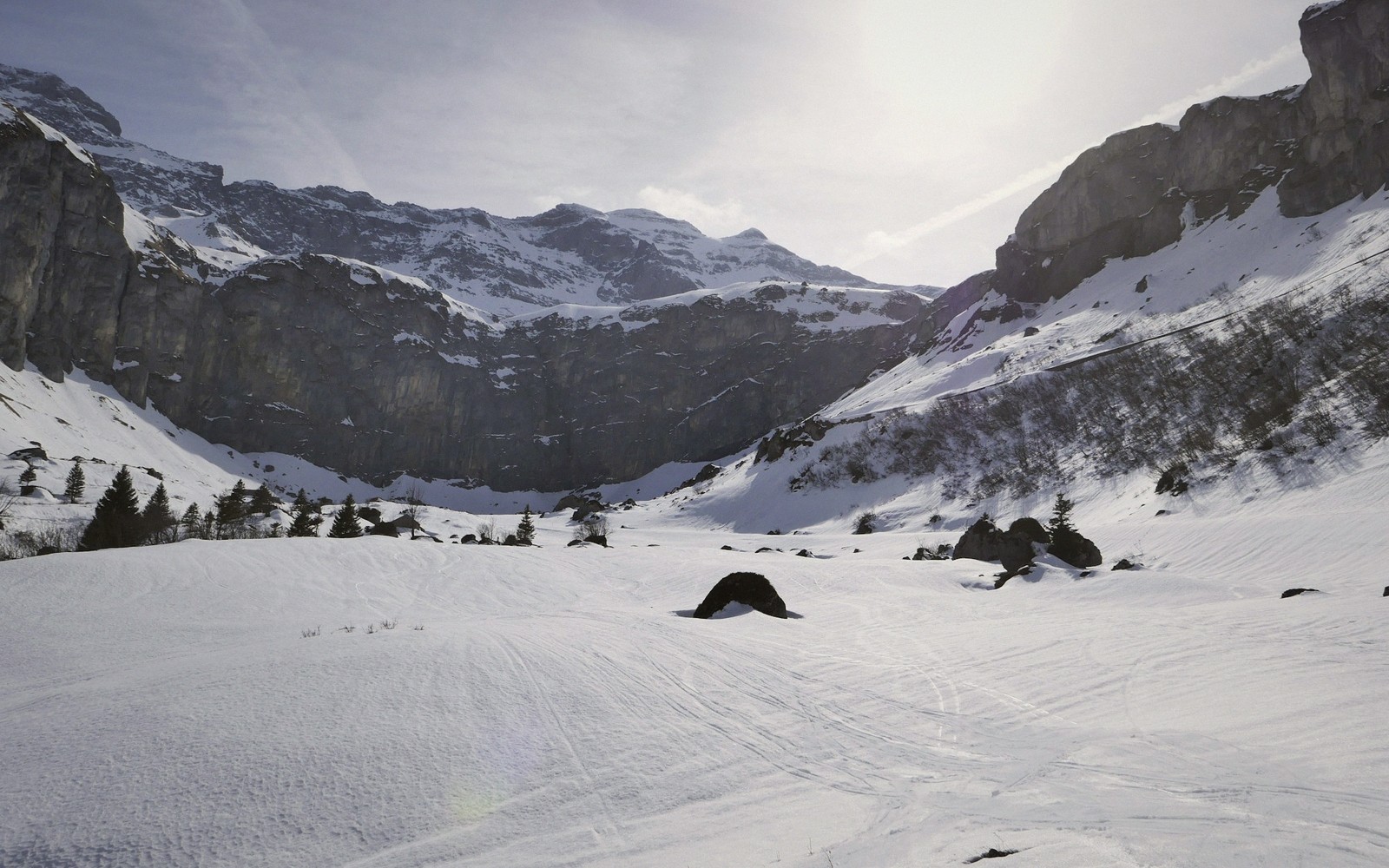
A guided run-by-run tour of Le Grand Domaine, from the village nursery slopes to the long red that drops you back to your door.
Saint-François-Longchamp sits at around 1,450 metres, high enough to guarantee decent snow cover through a proper winter, low enough that the village itself feels lived-in rather than clinical. From the moment you clip in at the base, the mountain opens in layers — forgiving greens and wide blues first, then the deeper bowl, then the long ridge that connects you to the rest of Le Grand Domaine and, when you're ready, the run that carries you all the way back to the village in one unbroken descent. What follows is a run-by-run tour, roughly in the order a first or second day here tends to unfold.
1Getting your legs: the village slopes
The lifts nearest the village are where most people spend their opening hour, and rightly so. The terrain immediately above Saint-François-Longchamp is gentle without being featureless — a set of wide, well-groomed green and easy blue runs that arc back down to the resort's lower station. The gradient is honest: enough pitch to give a beginner a sense of real movement, not so steep that a nervous skier spends the morning in a snowplough. These are good first-lesson slopes, broad enough that you won't feel crowded even on a busy weekend morning.
What's useful here isn't just the angle — it's the orientation. These lower runs face broadly south-west, which means they catch afternoon sun well into March. That matters on cold January mornings: you can warm up in the relative shelter of the treeline, then move up the mountain once you've found your rhythm. The pistes here are not labelled with the glamour of famous named runs, but they do the job that good nursery terrain is supposed to do: they build confidence without demanding anything from you.
The lifts serving this zone are quick to reach from most accommodation, and the short runs mean you're back on a chairlift within minutes. It's also where ski school classes tend to cluster in the early sessions, so if you're travelling with newer skiers, this is the natural meeting point before the group splits for the day.
~1,450 mvillage base altitude
~2,550 mupper ski area altitude
~1,100 mapproximate vertical drop, base to summit
2Into the bowl: blues and quiet reds
Once you've loosened up, a lift takes you into the broader upper bowl — the heart of Saint-François-Longchamp's own ski area before it connects with Valmorel over the ridge. This is where the skiing opens up properly, and it's worth pausing at the top of the lift to take it in. The terrain spreads wide here: long, undulating blue runs that let you carry speed across a broad face without committing to anything technical, and a handful of reds that peel away toward quieter flanks of the mountain.
The blues in this section are the resort's bread and butter. They're genuine intermediate terrain — not flattened out or dumbed down, but groomed to a smooth, fast surface that rewards good technique without punishing the occasional wobble. On a clear day the views across toward the Lauzière massif fill the left half of your vision, and if you stop briefly at the right point on the traverse, you can see down into the Maurienne valley far below. It gives you a useful sense of where you are in the landscape: a shelf of skiing cut into the southern side of a high ridge, facing a vast and sparsely populated valley.
The quieter runs in this bowl deserve more attention than they sometimes get. Les Envers — as the name suggests, the shaded, opposite-facing flanks of the mountain — can hold snow in better condition than the sunnier slopes when temperatures climb in spring. The gradient is consistent and the lines are long, which means you can settle into a rhythm rather than constantly adjusting to changing terrain. On a midweek morning, these runs can be strikingly quiet: the crowds thin out once you're away from the main lifts, and you might find yourself skiing a full piste without seeing another group ahead of you.
Le Grand Bois, the wooded sector that drops through the larch and fir on the lower-middle part of the mountain, offers something different again. Tree skiing in French resorts is often underrated, and the runs through this section have a gentler, more enclosed character that changes the mood entirely after an hour of wide-open bowl skiing. When visibility drops — the cloud that can roll in fast over the ridge on an unsettled afternoon — this is where experienced skiers head. The trees give definition to the slope when the flat light bleaches out the open faces.
What follows is a run-by-run tour, roughly in the order a first or second day here tends to unfold.
3La Madeleine: the long run home
The run named La Madeleine is the axis around which the whole ski day at Saint-François-Longchamp tends to turn. It starts from the highest accessible point of the French-side terrain — close to the ridge where the lift system approaches the Col de la Madeleine — and drops all the way back to the village. In terms of raw vertical, it's one of the longest continuous pistes in this part of the Maurienne, and it earns that status.
The upper section is classified red, and justifiably. The pitch is genuine from the start: a sustained, open face where the mountain doesn't give you much flat ground to collect yourself, and where the snow surface — wind-affected on exposed sections near the top — can vary considerably. In good conditions it's exhilarating; after a warm night followed by a cold morning, the upper part can be hard and fast, so it rewards an early start when the piste patrol has had time to work it.
As you descend, the character of the run shifts. The gradient eases through the middle section, which becomes a long, rhythmic cruise — the kind of run where you stop thinking about technique and simply ski, reading the terrain ahead and letting the mountain move underneath you. The middle section also offers some of the finest views of the whole area: to your right, the ridge folds away toward the ski area of Valmorel on the far side; ahead and below, the rooftops of Saint-François-Longchamp slowly come into focus.
The final third drops through the lower slopes above the village, linking back into the green and blue terrain you started on. By this point your legs will have covered a significant amount of vertical, and the gentler gradient here is welcome. The run feeds naturally back toward the base lifts, which means you can turn immediately and head back up, or — and this is often the right choice by mid-afternoon — simply follow the slope all the way to the nearest café-bar and call it a productive day.
A run like La Madeleine rewards repetition. On a first day you'll be managing it section by section; by the third or fourth time, you'll start to ski it as a whole, feeling where to carry speed and where to hold back, letting the terrain guide you rather than fighting it. That's when the run stops being a descent and becomes something closer to a conversation with the mountain.
4Reading the whole ski area
What makes Saint-François-Longchamp work well as a ski destination — rather than just a ski hill — is the variety compressed into a modest altitude range. Between roughly 1,450 metres and 2,550 metres, you have genuine beginner terrain, long and satisfying intermediate blues, shaded runs that hold snow late, tree runs for bad-weather days, and a flagship descent that ties the whole area together. There's no single zone where you'll exhaust the options in a day.
The area also connects — via the lifts crossing the Col de la Madeleine ridge — into the broader Le Grand Domaine, where the combined terrain with Valmorel adds significantly more mileage and variety for stronger skiers looking to push further. But it's worth spending at least a day fully on the Saint-François side before crossing over, not least because you'll ski the home runs better once you know them.
The shape of a good day here, broadly, is: start on the village slopes to warm up, move into the bowl and spend the mid-morning picking through the blues and quieter reds, take a long lunch on a south-facing terrace somewhere around mid-mountain, then finish the afternoon with La Madeleine — ideally two or three laps of it while the light is still good and the piste hasn't been skied out. The mountain rewards that kind of pacing. Go hard at it all day and you'll be tired without feeling you've understood the place. Take it in sections, and by the end of the week it will feel like yours.
Best runs · where to point your skis
Grade
Run
Why ski it
Red
La Madeleine
Top to village — long, rolling, the marquee run
Blue
Le Grand Bois
Wide cruiser threading through the larches
Red
Les Envers
North-facing, holds the driest snow late in the day
Green
Le Petit Bois
Gentle village nursery — first-morning friendly
Black
Combe des Chasseurs
Steep and quiet, for strong legs only
Savoie · Maurienne · French Alps
Saint-François-Longchamp on the road to the Col de la Madeleine, Savoie.